
Reaction Rate Simulator see collisions and reaction curves speed up

Change concentration, temperature, particle size, and catalyst, then watch particle collisions and compare how fast the reaction finishes.

Read the guide

Reaction Rate Simulator interactive collision lab

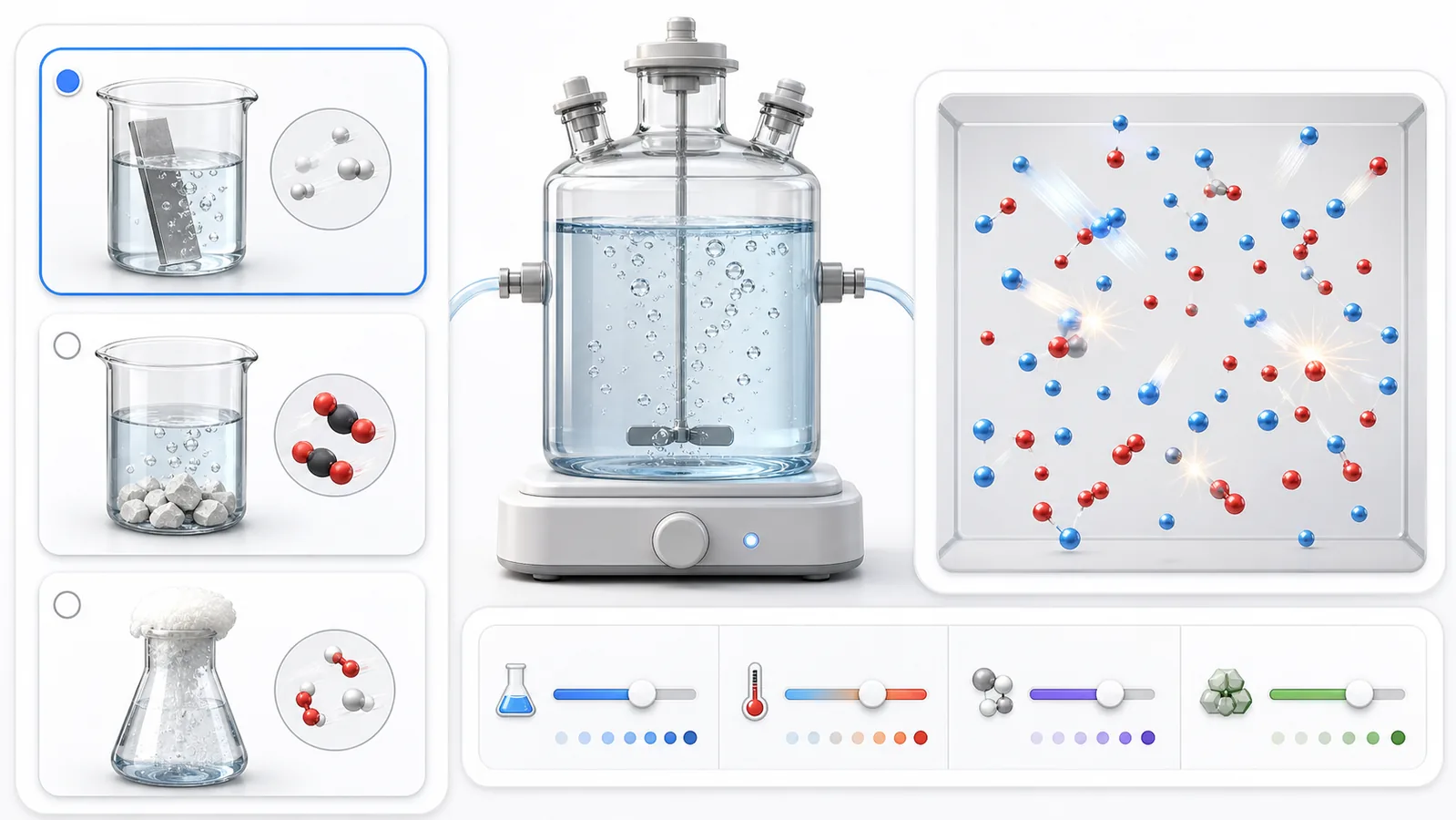
Start Reaction Rate Simulator here: choose a reaction scene, tune concentration, temperature, particle size, and catalyst, then compare effective collisions, gas generation, concentration drop, and completion time.

Controls

Set one reaction condition at a time or combine changes to see how the collision model responds.

Virtual reaction bench

Magnesium + hydrochloric acid

Medium rate

Effective collisions

0 /s

Estimated finish time

0 s

Gas generation speed

0 mL/min

Reaction curve

Curve

Current run

Collision theory explanation

Condition comparison

Condition Time Rate

Change a condition, then add a comparison run to see which setup finishes faster.

Principle check

Reaction Rate Simulator is an educational model. The curves are simplified to show trends from collision theory, not to replace measured kinetic data.

Reaction Rate Simulator collision workflow

Reaction Rate Simulator links condition sliders, particle collisions, gas collection, and reaction curves in one student-friendly lab.

Reaction Rate Simulator scenario controls

Choose magnesium with hydrochloric acid, calcium carbonate with hydrochloric acid, or hydrogen peroxide decomposition, then tune the factors that change rate.

Reaction Rate Simulator preview showing reaction scenario cards, concentration, temperature, particle size, catalyst controls, and particle collisions

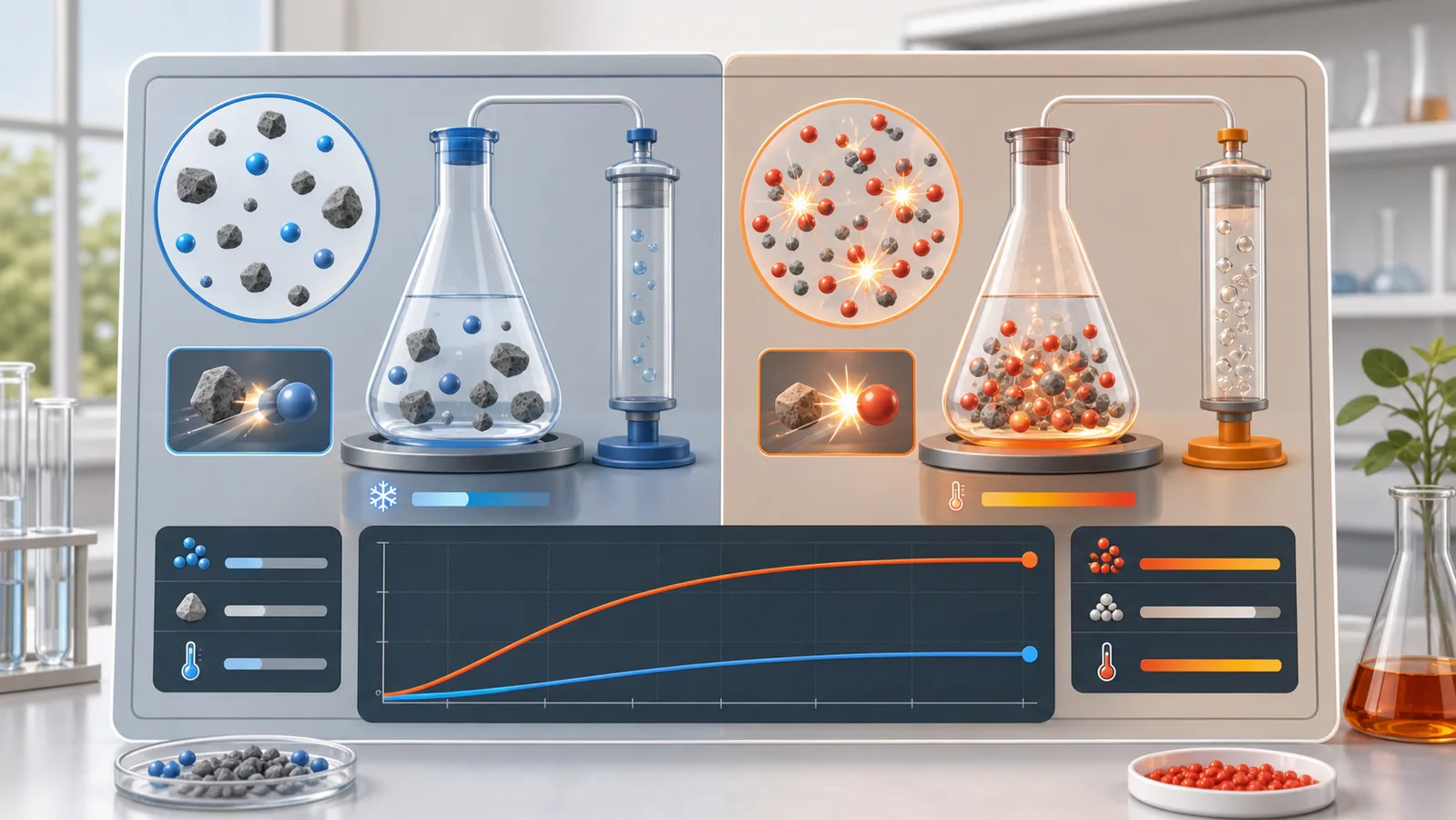
Reaction Rate Simulator comparison curves

Reaction Rate Simulator compares completion time, gas speed, effective collisions, and concentration decrease so students can explain why one setup is faster.

Reaction Rate Simulator preview showing slow and fast reaction conditions with particle collision bursts and reaction rate curves

Reaction Rate Simulator quick guide

Use this Reaction Rate Simulator guide to isolate concentration, temperature, surface area, and catalyst effects.

  1. Reaction Rate Simulator choose a reaction

    Pick a reaction scene that matches the lesson: metal plus acid, carbonate plus acid, or hydrogen peroxide decomposition.

    • Use magnesium with acid to discuss hydrogen gas formation.
    • Use calcium carbonate with acid to connect surface area and carbon dioxide production.
    Open Reaction Rate Simulator
  2. Reaction Rate Simulator change one factor

    Adjust one control first, then watch particle speed, effective collisions, gas generation, and concentration curves update.

    • Increase concentration to create more collision chances.
    • Decrease particle size to expose more reacting surface.
  3. Reaction Rate Simulator compare runs

    Save a comparison run, change another condition, and explain why the finish time or gas speed changed.

    Keep all other variables constant when you want a fair comparison.